
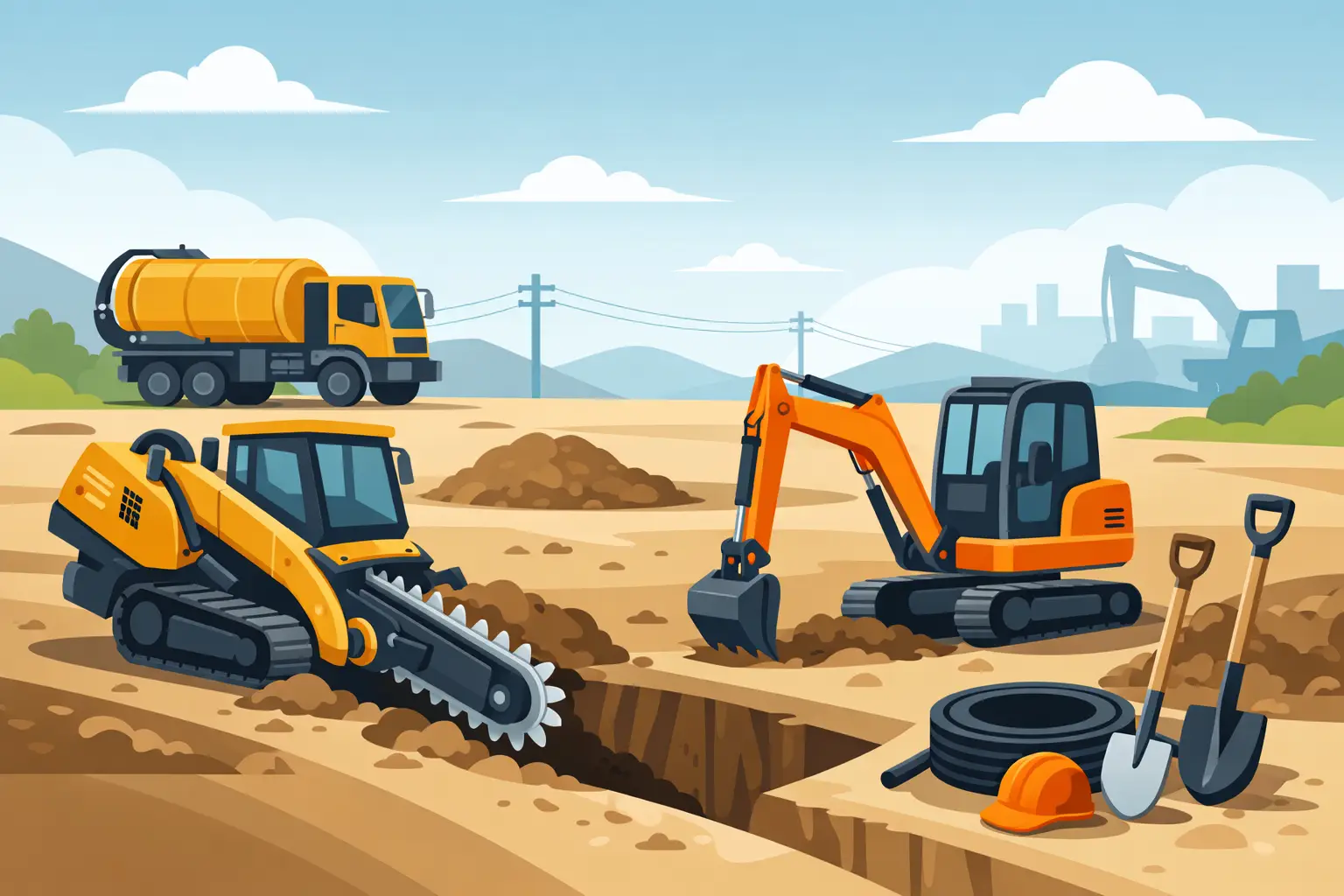
A trench that should take half a day can blow out into a full weekend if you turn up with the wrong machine. That is why choosing the best equipment for trenching jobs matters from the start. Soil type, trench width, depth, access, spoil handling and reinstatement all change what works best on site.
For some jobs, a dedicated trencher is the quickest and cleanest option. For others, a mini excavator, skid steer or posi track will get more done because trenching is only one part of the task. The right choice is not always the biggest machine. It is the one that matches the ground conditions, site access and the work that needs doing before and after the trench is cut.
How to choose the best equipment for trenching jobs
Start with the trench itself. If you are cutting a narrow run for irrigation, electrical conduit or poly pipe, a walk-behind or ride-on trencher can be hard to beat. It gives you a consistent trench width, keeps spoil close to the line and is usually faster than digging the same run with a bucket.
If the trench needs to be wider, deeper or tied into other excavation work, an excavator often makes more sense. The same applies if you are dealing with mixed ground, existing services, tree roots or tight areas where you need more control. Excavators are slower for long, narrow runs, but they are more versatile.
Then look at access. A suburban backyard, side access path or tight commercial site can rule out larger gear straight away. Weight also matters. Soft ground, finished surfaces and paved areas may push you toward compact equipment that is easier to manoeuvre and less likely to leave a mess behind.
Finally, think beyond the dig. Trenching jobs rarely finish when the ground is opened up. You still need to move spoil, place bedding, backfill, compact and clean up. That is where pairing the trenching machine with the right support equipment can save more time than upsizing the main machine.
Mini excavators for trenching work
Mini excavators are one of the most useful options for trenching because they handle more than one task well. They suit plumbing, drainage, electrical, landscaping and general construction work where trenching is part of a broader job. A mini excavator can open trenches, expose services carefully, shape pits and help with backfill once the installation is done.
Their biggest advantage is control. Around live services, retaining walls, footings and fences, that control counts. You can also swap bucket sizes to suit the trench width and work in tighter areas than larger earthmoving gear allows.
The trade-off is speed on long straight runs. If you have hundreds of metres of narrow trench to cut in clear ground, an excavator is usually not the fastest choice. It also leaves a wider disturbed area because the machine needs room to track and slew. Still, for jobs where conditions change across the site, mini excavators are often the safest all-round pick.
Dedicated trenchers for narrow, straight runs
If the brief is simple and the trench is narrow, a dedicated trencher is often the best equipment for trenching jobs. This is especially true for irrigation lines, ag drains, cable runs and light service installation in open ground. A trencher is built to do one thing efficiently, and on the right site it does it very well.
The clean trench profile is a big plus. You get a more uniform cut, less over-excavation and faster production across distance. Spoil placement is also more predictable, which helps when you are trying to keep a tidy work area or reduce reinstatement time.
But trenchers are not the answer for every site. Rocky ground, heavy roots, broken fill and unknown underground conditions can slow them down fast. They are also less useful if you need to widen sections, dig pits or shape around obstacles. In those cases, the speed advantage can disappear pretty quickly.
Skid steers and posi tracks as support gear
A skid steer or posi track is not usually the first machine people think of for trenching, but on many sites it is what keeps the job moving. Once the trench is open, spoil has to go somewhere. Materials need to be brought in. Backfill has to be managed efficiently. This is where a loader earns its place.
A skid steer works well on firmer, tighter sites where manoeuvrability matters. A posi track is better when the ground is soft or rough and you want lower ground pressure with good pushing power. Either option can save a lot of hand labour and reduce turnaround time between digging, installing and reinstating.
If trenching is only one stage of the project, hiring a support loader can be smarter than stepping up to a larger excavator. You get better workflow without sacrificing access or control.
When a larger excavator is the right call
There are jobs where compact gear simply is not enough. Deep service trenches, bulk drainage work, large civil cuts and jobs with significant spoil volumes can justify a larger excavator. More reach, more breakout force and bigger bucket capacity all add up when trench dimensions increase.
This is also where loading spoil straight into a tipper or stockpiling quickly becomes important. On bigger sites, larger excavators keep production up and reduce cycle times. They are also better suited to harder material where a small machine would spend too long fighting the ground.
The downside is obvious. Larger machines need space, transport planning and suitable ground conditions. They are not ideal for restricted residential access or finished landscapes. Bigger is only better when the site actually supports it.
Ground conditions change the answer
The best machine on paper can be the wrong one once you hit the ground. Sandy soil is usually quick to trench, but it can slump, especially if the trench is left open too long. Clay can hold shape better, but it can be slow going when it is dry and sticky when it is wet. Rocky ground changes everything again.
That is why hire decisions should be based on the actual site, not just the trench dimensions. If you know there are roots, rubble or old fill, a more versatile machine is often the safer option. If the ground is clean and consistent, a trencher can be the faster and cheaper choice.
Existing underground services matter too. Where accuracy and careful exposure are critical, excavators usually offer better control than a high-speed trenching setup. Productivity matters, but not if it creates rework or risk.
Don’t forget compaction and clean-up
Good trenching work is not just about opening the ground. Once services are laid, the trench needs proper backfill and compaction. If that part gets rushed, you can end up with settlement, surface failure or a callback later.
Depending on the job, that may mean adding a plate compactor, rammer or other compacting gear to the hire. For landscaping and residential work, even a small compactor can make a big difference to the finished result. It is also worth thinking about trailers, tipper trucks or pumps if the site conditions call for them.
This is where practical planning pays off. The trenching machine might be the headline item, but support equipment often decides how quickly you get off site.
Hiring the right trenching equipment without wasting money
Buying trenching gear only makes sense if you use it constantly. For many contractors and project crews, hire is the better option because it lets you match the machine to the job instead of forcing one machine to cover everything. That means better productivity, less downtime and fewer compromises on site.
It also helps when jobs vary week to week. One day you might need a mini excavator for a tight drainage run, and the next you might need a trencher for long irrigation lines. Flexible hire makes that possible without tying up capital in machines that sit idle between jobs.
For Gold Coast operators, that local turnaround matters as much as the machine itself. If you can get the right gear quickly, with practical advice from people who know the fleet, the whole job runs smoother. That is exactly why many crews work with providers like Small Hire when they need dependable equipment without the run-around.
The best equipment for trenching jobs is the gear that fits the trench, the site and the full scope of work around it. Get that call right, and everything after the first cut gets easier.

Add comment