
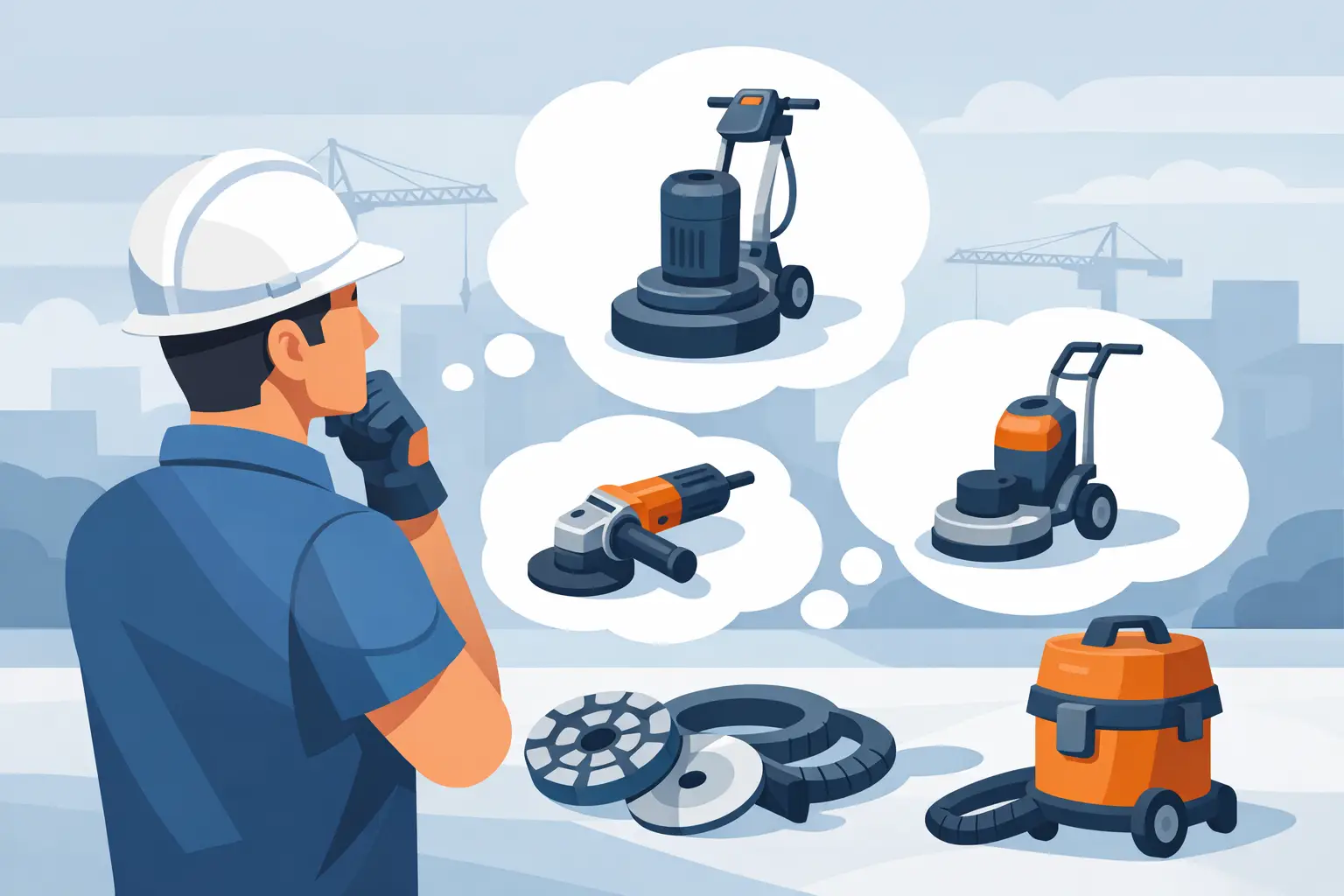
A concrete grinder that is too small will waste your day. One that is too aggressive can chew through the surface, load up your tooling and leave you fixing problems you did not start with. If you are working out how to choose concrete grinder equipment for a real job, the right starting point is not brand or price – it is the slab, the finish required and how much material needs to come off.
Most grinder problems come from a mismatch between machine, tooling and job conditions. A smooth warehouse floor, a glue-covered shop fitout, and an uneven outdoor slab all need different setups. If you get that part right early, you finish faster and avoid hiring the wrong gear twice.
How to choose concrete grinder equipment
The quickest way to choose properly is to answer three questions before you book anything. What are you removing, how much area are you covering, and what finish do you need when you are done?
If you are taking off thin paint, adhesive residue or light high spots, a smaller grinder can be enough. If you are stripping thick epoxy, levelling rough concrete or preparing a large commercial floor, you will usually need a heavier machine with more grinding width and better dust control. If the end result needs to be polish-ready or suitable for a coating system, the tooling choice matters just as much as the grinder itself.
That is why there is no single best concrete grinder. It depends on whether the job is edge work, tight access, open floor area, heavy removal or fine surface preparation.
Start with the job, not the machine
A lot of people look at grinder size first. That makes sense, but it is not the best place to begin. Start by checking the slab condition.
If the concrete is hard and dense, you may need different diamonds than you would on a softer, more abrasive slab. Hard concrete can glaze tooling if the bond is wrong. Softer concrete can wear diamonds too quickly. The machine still matters, but the slab will often decide whether the grinder works efficiently or just burns time.
Then think about what sits on top of the slab. Glue, waterproofing, paint, tile adhesive, sealer and epoxy all behave differently under a grinder. Some coatings break up cleanly. Others gum up and need the right segment or cup wheel to stop the job turning into a mess.
The last part is the finish. There is a big difference between rough prep for a new coating and a cleaner, flatter finish for polished concrete stages. If you only need mechanical keying, you do not need to chase a fine finish. If the slab needs to be consistent and presentable, the grinder and diamond sequence need to suit that goal.
Small grinders for tight areas and short runs
Smaller concrete grinders are the right call when access is restricted or the job is limited to a small area. Think bathrooms, residential thresholds, edges, patch repairs, trip hazards or touch-up work around columns and walls.
They are easier to load, easier to manoeuvre and often make more sense for short hire periods. If you are only fixing a section of slab or preparing a compact space, a smaller unit can be quicker overall because you are not battling bulk and setup time.
The trade-off is coverage. On larger jobs, a small grinder means more passes, more operator fatigue and slower production. It can still get the job done, but not always at a rate that makes sense.
Larger grinders for open floors and heavier removal
When the area opens up, a larger grinder usually pays for itself in time saved. More grinding width means better productivity, especially on warehouses, retail floors, sheds and broad residential slabs.
Heavier machines also tend to track better and keep more consistent contact with the slab. That matters when you are removing coatings or trying to flatten uneven sections. Weight can improve cutting performance, but it is not always an advantage if the slab is delicate, access is awkward or transport is an issue.
If you are working upstairs, through narrow entries or in occupied spaces, machine size can become a practical limit. A bigger grinder is only better if you can actually get it where it needs to go and run it safely.
Power supply changes the decision
One of the biggest mistakes on site is choosing a grinder without checking power. Some units are straightforward on standard power. Others need more than what is available in a house, tenancy or temporary site setup.
Before you lock anything in, check what power is on site, where it is located and whether extension leads will affect performance. A machine that suits the slab but cannot run properly is the wrong machine.
Petrol options can help in some outdoor situations, but indoors they are usually not practical because of fumes and ventilation. For indoor floor prep, electric grinders with proper dust extraction are generally the safer and cleaner option.
Tooling does the cutting
If you remember one thing, make it this: the grinder carries the tooling, but the tooling does the work. You can hire a good machine and still get poor results if the diamonds do not suit the slab or coating.
Coarse diamonds are used when you need faster removal. Finer grits are for refining the surface. Bond hardness also matters. On hard concrete you usually want a softer bond so the diamonds expose properly. On soft concrete, a harder bond can last longer.
There is no value in over-specifying tooling either. If the slab only needs light preparation for a coating, an aggressive setup can leave scratches or remove more material than needed. If the surface has thick glue or heavy epoxy, going too light can slow the job to a crawl.
This is where it helps to explain the actual job rather than just asking for a grinder. A good hire counter will match the machine and tooling together, not treat them as separate decisions.
Dust control is not optional
Concrete grinding creates a huge amount of dust unless the setup is right. On occupied sites, indoor jobs and finishing work, proper extraction is part of choosing the machine.
A grinder paired with the correct dust extractor keeps the site cleaner, improves visibility and reduces cleanup time at the end. It also helps the machine perform better because dust is being removed instead of building under the head or across the work area.
If you are grinding indoors, around other trades or in a finished space, do not treat dust control as an add-on. It is part of the job cost and part of doing the work properly.
Edge work and corners need a separate plan
A wide floor grinder will not do everything. You still need to think about edges, corners and tight spots around penetrations or walls.
That usually means allowing for a hand grinder or edging grinder as part of the setup. If the job has a lot of perimeter work, that can affect what machine package makes sense. There is no point smashing through the middle of a floor quickly if the edges then drag on for half a day.
For some jobs, especially smaller residential work, the edge detail can take almost as long as the open slab. Factor that in early.
Hire period, transport and handling matter too
If you are deciding between two machines, the best choice is often the one that fits your timing and site logistics. A larger grinder may cut faster, but if it takes more effort to transport, unload and set up, the gain can shrink on short jobs.
That is where flexible hire periods can make a real difference. For a quick prep job, a shorter hire can keep costs down. For a larger floor, weekend or project-based hire can be better value than trying to rush and return gear too early.
Also check how the machine is loaded and secured. Some grinders are straightforward in a trailer. Others need more planning. If your crew is tight on time, the practical side of getting equipment to site matters nearly as much as the spec sheet.
When to ask for advice
If the slab has multiple issues – old coatings, uneven sections, patch repairs and finish requirements – guessing is expensive. The safest move is to describe the substrate, area, access, power and end result you need. That gives the hire team enough to point you towards the right grinder, dust extraction and tooling combination.
For Gold Coast jobs, that sort of practical advice is often what saves the most time. Small Hire deals with trade and project customers who need to keep moving, so the aim is simple: match the gear to the work and avoid wasted trips.
A concrete grinder should make the job cleaner, faster and more predictable. If you choose based on the slab, the removal required and the finish you actually need, you will be a lot closer to getting off site on time.





Add comment